
updated 14 January 2009 17.30hrs Menu (Link): Navigation link is moved to the bottom of this page.
LOAN INTEREST RATE:
Law & Facts
FACTS:
A simple hypothetical test will prove the double standard and dubious method of calculation adopted by lenders since 50 years. Ask them to workout the weekly repayment for a loan of $ 100,000 for 30 years at 8% p.a interest as they normally calculate, it would be $ 169.23 per week.
Now, ask them (instead of taking a loan), you want to open a (any type of savings account) savings account with them. You will deposit weekly $ 169.23 for 30 years and ask them to 'assume' the same 8% p.a. as interest rate. Ask them to calculate the interest in the way they calculate on any type of deposit account and find out the total accumulated amount of your deposit + interest at the end of 30 years.
Will your deposit become $ 100,000? If not (surely will not and it will be far less than $ 100,000). This difference is the HIDDEN additional profit due to the different methods used in calculating interest on deposits and interest on loan. That is, on your deposits they give SIMPLE interest but on your borrowing they calculate COMPOUND interest compounding MONTHLY . No deposit taking institutions and none of their deposit products, including your money in Superannuation Fund get this COMPOUNDING MONTHLY treatment. Does it mean our money has the smell of sweat and stinks that it treated differently whereas the lenders money is having best fragrance and gets treated with hidden method of calculation?
This profit is the additional profit NOT disclosed and NOT easily understood by most of the population around the GLOBE. The normal profit any one thinks that the deposit taking institutions make is for eg, if the lending rate is 8%p.a the deposit interest rate would be less, say 5% p.a. So people can only think that the profit they make is only due to this difference in the rate and their fees and charges.
But NOT true, when you keep a deposit if bank/deposit taking institution says they give 8% p.a, it means only 8% p.a. even when calculated and given to you, but when you borrow if the lender says 8% p.a it is NOT 8%p.a when they calculate, it becomes 23.15%p.a (if it is a loan for 30 years) just by the method of calculation adopted. So in reality it is the HOME LOAN or the TERM LOAN where they make the cream by deceptive method of NOT DISCLOSING the hidden profits!
Is this NOT a double standard from these institutions? Your money is dealt with differently to your disadvantage not only in the rate of interest they give (which is apparent) but in the hidden fashion, sneaky or dubious way in the ‘method of calculation’.
Whereas in the same sneaky way and dubious/ undisclosed fashion they apply compounding monthly concept to your greatest disadvantage and for their best advantage. How could all the learned Judges accept this as “FAIR” (as I took the banks to court on the grounds of (1) unfair terms in contract and (2) NON disclosure of important term of the contract in an understandable manner for the borrowers!!!
But what would you do when you are not aware of (1) either the existence of difference in the method of calculating the interest on deposits as against the method applied to money lent and / or (2) the impact of such different method applied in calculating interest on deposits as against money lent. This is the double standard that exists in banks secrecy of profits in the last 50 years or so. This is what I brought out in the court cases against Westpac banking corporation, National Australia Bank ltd and Commonwealth Bank of Australia. It is not only these banks that do this, but all banks as a ‘gang’ against the weak borrowers. The law didn’t come to protect neither myself nor the interest of these weak borrowing groups, but vehemently supported the ‘gangsters’.
The typical wording in lending contracts are as, 'Interest is calculated on daily balance and debited to the account at the end of the month’. ‘And debited’ here means that the lenders ADD the interest amount so “calculated” (this is NOT the money borrowed), to the ‘principal owed’ (this is the money actually borrowed). So for the next following day when calculating interest, it is calculated on the total of principal actually borrowed + the interest calculated for the preceding period. This method is DEFINED mathematically as COMPOUND interest.
The compounding impact takes place in ‘ADDING/ DEBITING the interest at the end of each month’. So it is compounding ‘monthly’ (because interest is added to principal at the end of each month and then interest is calculated on the total for the following period.
Whereas when you have any kind of deposit account that you open for any amount with any bank/deposit taking institutions (INCLUDING YOUR SUPERANNUATION account balance, super annuation account doesn’t even accrue interest on the money held in the fund, you get only a profit share if the fund makes a profit, but if share market crashed you may lose your principal deposit held with the superfund!!!), on your deposit NO bank gives the compounding benefit of ‘ADDING interest calculated for each month to the principal and calculate interest for the following month on the total of principal and interest calculated for the preceding month.
Please read below the further explanations and arguments and supporting legislation references and calculations to appraise what is happening….
LAW:
The ‘interest on interest’ issue affects (1) Nationally (2) Internationally. You can buy all legislation books from "Information Victoria, 356 Collins Street, Melbourne 3000. Phone 1300 366 356. Titles are, "Fair Trading Act 1999" and "Victorian Civil and administrative Tribunal Act 1998", and "Consumer Credit (Queensland) Act 1994 Consumer Credit Regulation 1995". These are not expensive (may be less than $30) either. Residents of other states can contact the Government books retail outlet similar to one mentioned above for Victoria). Please visit view documents page here for evidences & court transcripts from the authorised court agent, for my cases against Westpac and direct link to legal database. 2 cases against Westpac have not been registered in legal database, a hush up.
A little information about Trade Practices Act 1974 and its predecessors:
An agreement enforceable in the court of law is called a 'contract'. The terms of agreement must be certain. If an agreement allows one party to change all the significant terms of agreement unilaterally, then it is definitely not a contract, in the spirit of it, though named as contract.
Until 1974 when Trade Practices Act was introduced as Federal Legislation to protect consumers (its mirror legislation in each state is called Fair Trading Act), for any disputes between the buyer and seller of goods and services were governed by (a) Sale of Goods Act (b) Contract Act and (c) Common Law.
In all these 3 there were deficiencies in relation to 'protecting consumers'. For E.g. in a carefully worded contract of any sale of goods and services, the seller can use 'caveat emptor' (let the buyer beware), as provided in the Sale of Goods Act. In essence, the seller can act deceitfully and still escape penalties just because somewhere in the contract something is worded to mean what they actually have done is explained in the contract.. In common law situation, you have to prove that you have entered into the contract solely by relying on a particular term of the contract that you are challenging in the court.
The special feature of Trade Practices Act 1974 is; it is meant for ‘protecting’ consumer from False Misleading and deceptive conduct by the supplier of goods and services. All transactions of goods and services are covered by this Act.
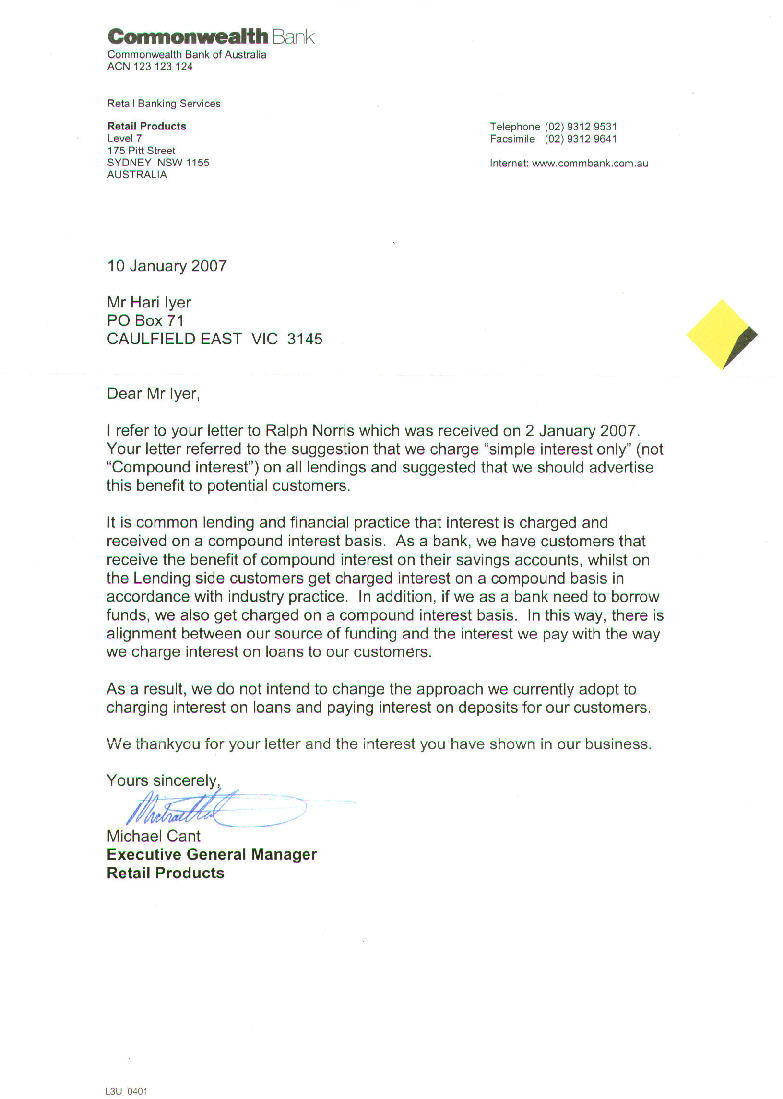
It is now BEYOND DOUBT (proved in the court, Special Counsel appeared for National Australia Bank agreed in the court, the confessional letter from Commonwealth bank CEO, all confirm interest charged on ALL lending products are compounding monthly. (Conspiracy, not an error. If these people confirm in writing the compounding, but banks' senior managers wrote to me that they charge only simple interest). Please see view document for scanned copies of these documents.
1. Nationally: It affects nationally in 2 ways (a) Legally (b) Practically. Both legally and practically it affects (i) the economy of the country (ii) the individuals. It affects these since last 40 or 50 years, continues to affect and would worsen for the future unless something is done. Please visit what I did, what you can do, and solution on this site for details.
(a) Legally:
1. Banks and other lenders (assumed by public as under constant government regulations and scrutiny) are continuously violating (over 40 years) section 52 and 54 of Trade Practices Act. Section 54 is a Criminal penalty provisions, for anti competitive behaviour. There exists un/spoken un/written 'Cartel' among suppliers of goods and services in banking industry. Please see view document 1 & 2 Commonwealth CEO wrote that compound interest is INDUSTRY PRACTICE!!. So there is a 'communist' behaviour in this matter and NO competition AT ALL among them (makes us wonder if we are in communist regime or a 'competitive market' based economy!
“A false, misleading and deceptive conduct”: as per section 52 of Trade Practices Act 1974 or section 9 of Fair Trading Act 1999 (a mirror state wide legislation reflecting the contents of federal legislation 'Trade Practices Act'). Section 9 of Fair Trading Act 1999 reads as follows; "A person must not, in trade or commerce, engage in conduct that is misleading or deceptive or is likely to mislead or deceive".
Section 8 (c) of Fair Trading Act 1999; "whether the purchaser was able to understand any documents relating to the supply OR possible supply of the goods and services". As proved in the court that the lenders knew it all that they are compounding monthly, but NOT disclosed, in the contract, that interest on interest is charged and the severity of impact of compounding monthly. The lenders are in a fiduciary capacity to be honest and transparent to the customers, as much as the parents are in fiduciary capacity to their trusted young kids.
Section 11 of FTA 1999: "A person must not, in trade or commerce, engage in conduct that is liable to mislead the public as to the nature, the characteristics, the suitability for their purpose or the quantity of any services". Compound interest is NOT suitable for working class public, suits to benefit business people, but not suitable for Taxation office or for Government revenue system itself!!
Section 32L of FTA expressly states that the contract CANNOT exclude this part. That is, no contract can claim compliance just because a customer signed the contract (leading the belief that the customer has 'waived' their rights).
Section 32W of FTA defines "what is an unfair term? A term in a consumer contract is to be regarded as unfair if, contrary to the requirements of good faith and in all the circumstances, it causes a significant imbalance in the parties’ rights and obligations arising under the contract to the detriment of the consumer".
Uniform Consumer Credit Code (a Federal Legislation governing the consumer credits, the legislation itself has left out (deliberately or otherwise), (i) if the code talks about simple interest or compound interest (ii) if the default method is simple interest or compound interest (if clear disclosure in consumer contract is missing).
2. Part IVA of Income Tax Act provides for Criminal penalty for a scheme promoted solely or predominantly for avoiding tax or for tax benefit. 'Interest Only Option' loan, promoted by Banks, satisfies the requirements of this section. The customers may not be aware of Part IVA but banks do and knowingly violate these.
3. GROSS NON COMPLIANCE with Mandatory Comparison Rate Legislation Act 2003. For interest rate quoted, they should disclose one single interest rate per annum taking into account the total cost of the borrowing (to the borrower). Please visit Ready Reckoner for this single percentage. Did the lender disclose this to you? (If not, this warrants immediate cancellation of license to lend. That is why in my case against Westpac I demanded cancelling their licence). But what lenders do? They know it all that they are using the market interest rate per annum with a compounding monthly effect of adding interest to principal every month and then charge interest on the total for the next period. But they apply the market rate per annum into the formula and bring out the 'Comparison Rate' (which varies by about 1% of the quoted rate, due to the fee and charges only).
Regulation 33F of Consumer Credit Regulations 1995, (page 38 and 39) reads as follows:
"(1) For the purposes of this part, comparison rates are to be calculated in accordance with this section.
(2) The comparison rate must be calculated as a nominal rate per annum, together with the compounding frequency, in accordance with this section.
(3) The comparison rate is given by the following formula - i = n x r x 100%, where "r" is the solution of the following - Aj/(1 + r) j = (Rj+Cj) / (1 + r)j (some part of this formula, with similar things on both sides of the equation, is unable to be reproduced, but it is called 't' sigma when j = 0)”. ‘r’ in the formula assumes the quoted rate is the simple interest rate per annum.
So (i) there is a recognition by the government as being aware of compounding interest (ii) government made it mandatory for the banks to take compounding 'frequency' (monthly/ quarterly/half yearly/annually) into account in calculating the nominal rate per annum (iii) but ALL LENDERS have applied the formula in (3) above, but DELIBERATELY left out the explanation of what 'r' stands for in (3) above!!!
(b) Practically:
The lender disclosing an interest rate percentage per annum which is quite alarmingly high compared to actual rate per annum applied. Worst of it is, that ONLY due to the method of charging the interest it can make the borrower (i) default and become bankrupt and/or (ii) to owe more than what was originally borrower, at the end of 25 years 30 years of ritually repaying the instalment amount.
But what is wrong if interest is compounded?
Two problems here (i) Practical deceit on borrowers (ii) Legal issue- a contract - worth a toilet paper, explained above.
(i) Practical Deceit on borrowers:
Interest rates per annum stated in the contract or announced by the lenders are totally misleading compared to the rate per annum applied to the loan.
Features of Compound Interest:
· The longer is the duration of loan (40 years, 30 years etc as against 5 years and 10 years), the higher is the actual rate charged, for any given rate quoted.
· The more the frequency of compounding (that is number of times interest is added to principal within a year, 12 times a year, when compounding monthly, as against twice a year, when compounding half yearly) the higher is the actual rate charged, for any given rate quoted.
· unless you make lump sum additional payment, (if regular repayments mentioned in the contract are the only amount repaid for 40 years or 30 years or so), you will NEVER pay even $1 off your loan principal AND at the end of paying so many years, you will owe MORE than what you borrowed
When we go for a loan, the following questions are in mind;
(i) Amount can we borrow
(ii) Repayment amount, frequency and number of repayments
(iii) The interest rate, and may be (iv) the total amount that will be repaid (multiplying repayment amount with number of instalments, it is very easy!).
We normally shop around for item (iii), to avail a 'lower interest rate'. Item (i) and (ii) are usually covered by the lender's own rules and regulations. The borrower must provide (a) income details (payslip or Tax Returns and Profit and loss statements etc) and (b) details as to stability of the income, like length of employment/business etc.
For e.g. Jack wants 'ABC bank Ltd' to loan of $ 370,000 to buy a house. He has a second choice of another house for $ 300,000.
He is an employee, his family's total income is $ 160,000, market interest rate 8.5% p.a. compounding monthly, for 30 year. We also assume (1) he drinks heavily, smokes and is a spend thrift. His family living expenses is $ 55,000 p.a. (2) he doesn't drink or smoke and is savings minded. His family living expenses is $ 25,000p.a (3) lenders' own rules provide $ 42,000 as minimum living expense for his family size and commitments.
The bank/lender assess his 'ability to repay' the loan based primarily on (his income $ 160,000 less his living expenses. Living expenses used in this calculation is the greater of $ 55,000 or amount as per lenders own rules). His disposable income is $160,000 - $55,000 = $ 105,000. Approximately 3 times of this amount is what the lender would lend (as they work out his instalment amount as $ 2422.08 per calendar month). Unless Jack proves he earns more, they cannot lend more than $ 315,000. Even if Jack promises to cut his expenses (and repay $ 2844.98 per calendar month, i.e. $ 422.90 per month more (bank denies his ability to repay this based on their own rules) to get loan of $ 370,000. The bank would say, 'don't kill yourselves to pay us', 'sorry only $ 315,000'.
If we assume Jack as conservative as in e.g. (2) above, the standard expenses as per lender for Jack's family size is $ 42,000. Though Jack and his family maintained themselves in the past, in $ 25,000, the bank would lend $160,000 - $42,000 = $ 118,000 multiplied by 3, $ 354,000. How so ever Jack can prove his expenses to be only $ 25,000 the bank would not lend more than $ 354,000, for, as per bank rules, his repayment capacity is ONLY up to this amount of loan. In other words, if the loan is more, repayment requirement will be more and as per his income he cannot pay the increased repayment.
Jack can either take it or leave. Let us say that Jack took $ 315,000 loan and buy the house for $ 300,000 + additional refurbishment costs $ 15,000. He repays $ 2422.08 per calendar month. If Jack is unlucky, the market interest rate goes up by 0.8% p.a. (at any point in time, say in first 5 years), the bank would adjust his repayment to $ 2602.85 per calendar month, though in the bank's own words and as per their rules, he cannot pay more than $ 2422.08, "UNLESS HIS INCOME INCREASES". But now market interest rate is increased and NOT Jack’s INCOME and not Bank’s cost of lending (as they already lent the money)! Since he cannot pay the increased amount and wants continues to pay only $ 2422.08, he will owe $ 328,235.57 after paying $ 874,369.97, in 30 years.
When Rate rises:
Either: after 30 years, owe more than borrowed amount!!
(i) If he continues to pay $ 2422.08, not the increased repayment:
He would repay $ 874,369.97 over 30 years, and have his balance owing is $ 328,235.57!!, after 30 years! So his money had a NEGATIVE VALUE that it couldn't reduce the principal by even $ 1. More badly of this $ 874,369.97, that it increased his original borrowing!!! (He only borrowed $ 315,000, but after 30 years he owes $ 328,235.57!!). (Does his money stink? and bank’s money has fragrance!!!).
OR default and lose the property
(ii) If he is forced to pay the increased repayment: $ 2602.85 per calendar month: (as in most loan contracts repayment is automatically readjusted based on market interest rate)
Jack would eventually default as his income has NOT increased and he may not be able to cut his expenses for too long. He will loose the property as Bank goes bank on their rules about his ability to repay, is a rule for convenience and means nothing.
So out of 3 questions we had above when we went to bank for a loan;
(i) Amount we can borrow, calculated by the lenders using their own rules, is MEANINGLESS.
(ii) Repayment instalment amount, number of repayments are both subject to adjustment as per market interest rate. So these are NOT certain and subject of UNILATERAL change by the banks. Borrower can only change the frequency of repayment, which doesn't mean any big difference in total repayment over the entire term of loan, not even a $ 1000 for the entire period. This is the only right borrower has.
(iii) the interest rate quoted (has hidden information regarding monthly account keeping charge, the variation of this small rate difference between lenders is usually covered by the additional fee charged), is again subject to change from time to time unilaterally by the bank (Though can fix it for some time, but cannot be fixed for entire period, 25 years!!). Due to the above paragraph in blue; so it is needless to say here that the (iv) information of 'total amount repayable/paid over the entire term of loan' .is HOPELESS......hahahaha!!! (please note my case against National Australia Bank is dismissed by Justice Bowman, due to the ONLY defence raised by Mr Chris Archibald represented NAB in VCAT saying that the contract shows ‘total amount repayable’ (without allowing to continue the proceedings further). He didn't raise this question to me when he allowed me to explain all the issues surrounding the 'hidden' compounding method of calculating interest.
Let us analyse further about compound interest:
1. Practical Deceit on borrowers:
The issue is NOT about whether the lenders are making (substantial/ normal) profits or losses or whether they are using the money so earned in the correct way or wrong way and not about whether the consumer is able to repay the loan or not.
To give an example; Fill Petrol
When we fill petrol the pump shows us (i) the price per litre (ii) number of litres we fill in. All know that the multiplication of (i) and (ii) gives the 'total amount payable', say (iii). Few weeks back it was shown in TV how when we fill fuel in different petrol station the number of kilo meters we can drive varies significantly because of either (i) the quality of petrol and/or (ii) the quantity measured as one litre (1000 ml).
Though section 11 of FTA 1999, will catch the supplier, if the quality is not appropriate, but what it means when you believe 1000ml is 1 litre, but in some stations you get 800ml and in some 500 ml? In my language, it is simply 'STEALING' from unsuspecting (or consumer who is not in equal position with seller to understand how the pump works).
But what would you say, if ALL petrol stations have started using a new type of digital pump where all of them will give us only 400ml for every one litre shown on the pump meter?
1. It is hard to 'catch' these "dacoits" (day light robbers).
2. Even if one catches (simply the dacoit will try and escape using all possible avenues, even worse, if the dacoit is financially and resourcefully 'connected' with the government, it is even easier for the dacoit to escape.
3. Even if the dacoit is taken to court it is NOT an easy task to make him/her 'confess' that their pump has been (knowingly) set up to measure only 400ml for every one litre shown on the reading.
This is what I have done in the court in VCAT on 18th June 2007 and 20th June 2007(placed in view documents, you can see it directly from the VCAT database). But what Westpac Banking Corporation did on 19th March 2007 and 10th May 2007, successfully 'tried' me on the witness box (as if I am the criminal) and made me to pay $ 10,000 on the first case and about $ 13,000 in second case (both I did pay, as I am bound to honour the 'Learned Judges'). But what is worse in both with Westpac's case is that they made sure that the 2 cases against them NOT to go in legal database!!! No worries now you have the ‘transcripts’ in ‘view documents’ page of this site.
Variable loan borrowers subsidise for fixed rate borrowers:
When market rate is increased, the lender adjusts the interest rate and instalment amount, for those that have taken variable option on their loan (anyway, you can fix the rate for entire loan term, besides, when you fix the rate it is fixed at the rate higher than that prevails at the point of option). When the lender puts their rate higher, to ‘cover the cost’, it simply means that the variable option borrower ‘compensate’ the lender for what they are losing on fixed rate option borrowers.
Lenders and Builders Collude!
The builder’s price of the home is usually NOT challenged by the lenders (why? Is there a financial understanding between lender and builders?). If one wants to buy property from an individual, the property may not stand lenders’ valuation and hence risk of not getting loan. With builder, because the builder usually ‘arranges’ the loan for the borrower through their own contact with lenders, the ‘valuation’ of the property does not come in to question for approval. So the builder can make any mark up on their price (as more the price is more beneficial for builder as well as the lender). The losers are those that buy from builders. Individual owners intending to sell do not complain much as, when the new property price is put up by builders automatically old property prices too go high. We talk about ‘inflation’, who cares about this kind of unlawful understanding to control the property prices? (I had builders as clients in my accounting practice).
2. Legal issue as a contract: (any long term loan, anywhere, any lender):
In any borrowing, both borrower and lender must be sure of;
Varying the interest rate/ the amount of repayment/ or the duration of loan, all cost a fortune or life. They cost a fortune or life ONLY because the interest charged is NOT Simple interest (interest only the actual money you borrowed), but its COMPOUND interest (interest on money borrowed + interest on interest/ interest on money not borrowed).
Compounding can be, monthly (interest shown in your loan statement each month, 12 times a year, AND added to the balance), or quarterly (every 3 months, 4 times a year) or half yearly (every 6 months, twice a year) or annually (once a year) depending up on which country you live in. Interest is calculated daily, I agree with this part of calculation daily, no arguments about this, perhaps this may be the only right thing the lender does.
1. Fee and charges payable to the Government
2. Fee and charges payable to the Lender
3. Interest accrued on the loan
4. Principal owing to the lender”
From the 4 points above, who could recognise that swap of 3 and 4 would make it simple interest and current order as above means compound interest? At least I didn't in as much as the following people didn't;
Mr Tim Goss (national reconciliation manager of Westpac banking corporation)
Justice Merryln Harbison the head of Anti discrimination wing of VCAT
Ms Robyn Clarke (customer service manager of Westpac banking corporation)
Mr Strong (special counsel for Westpac banking corporation who made a sudden and magical appearance in VCAT on 19th March 2007)
Mr Anthony Thompson (national resolution manager of National Australia Bank)
Ms Tommy (lending manager of commonwealth bank of Australia, Cheltenham branch)
Mr Gary Carter (manager of Commonwealth Bank of Australia) assured 100% they are charging simple interest.
Narelle Hosking and Mario Brex (Commonwealth bank of Australia) did not want to say compounding.
But Justice Bowman, in his judgement has mentioned that the compounding monthly is ‘abundantly clear’. Section 8 of FTA 1999, is NOT expecting the understanding of the terms of a contract by a Judge or someone in that calibre, but it should be understandable by the purchaser/borrower (who could be anyone without much education or education in banking related discipline)
None of the 4 important term of the contract is constant. None of the above people knew it was compounding monthly (or at least pretended not knowing). Mind you, these happened since September 2006 until I was given an opportunity to spear in VCAT on 18th June 2007. Since that date there should be a change with the bank staff to let you know that they definitely charge compound interest. But still they may not tell you (a) it is compounding monthly and/or (b) the relative comparative simple interest rate (there is no table or calculator or formula available now to do this job. You have to rely on my excel downloads attached in this website to provide the comparative rate for your options)
Nothing is known/disclosed to the borrower. Nothing is promised to remain constant in the contract. Then what is the purpose of this so called ‘legal document’? But guess what, we all have been living in this kind of baseless contracts for over 4 decades.
The amount that is fleeced by the lenders in dubious and fraudulent (financial benefit derived by the lender by deliberately not disclosing information essential/ misleading the borrower) manner amounts to at least half of the actual loan sum borrowed. For e.g. a $ 100,000 borrowed at 6% p.a. for 25 years, the excess amount taken out of the borrower is at least $ 47,000 out of about $93,000 paid in interest.
When the lenders have to refund this amount back, it cannot be taxed as income in your hands, as this is the home loan interest paid earlier refunded now and no tax deduction claimed when interest was paid. When lenders have to pay back, they don’t work hard to repay (as how we do to repay our loans). They have to ask their insurers to pay back.
Even if no one is bothered about obtaining a refund of this excess interest fraudulently taken by the lenders in all these years (I don’t see any reason why they should not get refunded, after all, the lenders would get the money from their insurance companies to pay for these deliberate acts), the minimum a sensible society must do is to ensure that this non sense does NOT CONTINUE.
1. The rate---% p.a. mentioned is NOT simple interest (compounding and/or frequency of compounding NOT disclosed to you). Many branch managers of leading banks themselves, including their national reconciliation managers, proved that they are NOT even aware their bank is charging compound interest, though the CEO of CBA has clearly written of compounding. So obviously and definitely, they could not tell the borrower. Throughout the loan agreement & their usual terms and conditions, NO where you can come across the words "compounding" or "interest on interest".
2. Unless you make lump sum additional payment, (if regular repayments mentioned in the contract are the only amount repaid for 40 years or 30 years or so), you will NEVER pay even $1 off your loan principal AND at the end of paying so many years, and you will owe MORE than what you borrowed. (See Rate Increase).
3. The lender automatically adjusting the repayment instalment amount AND demanding the revised amount, when the employer doesn’t adjust the wages automatically as per interest rate increase) wouldn't it lead to a default? For none of the borrower's fault (except that borrower has not been told of the depth of the water they are getting in when loan agreement is signed).
4. What is the logic here, I fail to understand. For e.g., If Jack borrows $300,000 from ABC bank Ltd on 1st January 2000 at an interest rate of 6% p.a. for 25 years repayment period. ABC bank Ltd lends $300,000 it has on hand on 1st January 2000. If interest rate has increased in January 2008 to 8.5% p.a. in the market or in ABC Bank Ltd’s lending business, how can ABC Bank Ltd automatically increase the rate to Jack on the amount lent 8 years back? This is day light robbery! If for argument sake we say that ABC Bank Ltd has to adjust the rate for the time value of money (which is what is reflected in her original charge of interest in itself), the rate should have been adjusted at the time of lending.
The whole episode, when you read particularly the 'what I did' and 'view documents' sections of this website you will know the TOTAL LAWLESSNESS when it comes to banks and their operations! Since the lender can afford to and has access to specialised professional services and the fact that they make the Loan agreement and Usual terms and conditions and the fact they (the CEO and Managers at least at the policy making level) are fully aware and sure of all the above, is this act not stealing the money from unsuspecting borrowers.
Solomon Vs Solomon & Co Ltd
Yet we have examples of Solomon Vs Solomon & Co Ltd established as per British law in 18th Century where Mr Solomon used the constitution of Company law to defraud his suppliers. The supplier took him to courts and the courts did identify his intention to defraud suppliers, so did not want to acknowledge the existence of the Company Ltd as an entity, as they wanted to deliver true justice to society. Solomon took it to 'Privy Council' of the Parliament to see if those parliamentarians honour their own law, which they did and Solomon got free of debt, effectively cheating his suppliers.
But we have our courts here, the Judges understood the impact caused by the lenders on the society, understood the trouble I took to reach up to them, but dealt with me as you can notice from the preceding pages and in 'view documents' page.
Our politicians, I have approached both in Canberra and in Victoria, regardless of the political party they belong to, so that like 'Privy council' in Australian System, they can make sure the law they made is adhered by these lenders, but we find the lenders are the ones running the country, perhaps through their representation in some way. The law makers themselves do not support the implementation of the legislation by influencing re roaster of the judge to hear my case and to hush up the case!!!.
When I taught Criminal Codes Act in Victoria, I appraised the students that the criminal law is very weak to the extent that a defence lawyer does not have to prove that his client has NOT committed the crime, it is sufficient if the defence lawyer 'creates a doubt' in the minds of at least one of the 12 'juries' that there exists a possibility that the accused 'may not necessarily have committed' the crime. This is because of the religious philosophical background of the country that they do not mind a 1000 criminals escaping punishment but will ensure that NO INNOCENT is PUNISHED. This is the situation for the criminals themselves in countries like Australia.
But what happened in my case? I am not the one fraudulently charged interest and ripped of Australians, but took the industry to the court proving the point. What Justice? Harbison did, she gave the judgement that she did not want to go through whether the interest is compounded or not (this is the essence of my case itself, but she did not want to decide on that, please read the transcript from View documents). Contrarily, dismissed my case and penalised me to pay $ 10,000 to the offender, Criminal, Westpac Banking Corporation!!!
What Mr Vassie did? Went a step above in presiding over a case that on his own words he was not entitled to preside over and gave permission for 'Special counsel' Mr Strong to represent for Westpac Banking corporation against myself, a self represented applicant. Mr Vassie awarded 'full indemnity' of costs to Westpac that made me to pay about $13,000.
What more is, that these cases have not been registered/ made available to public from the legal database of Australia, successfully hushed up.
I can’t blame them; it is the teacher who taught these people the method of deriving judgement, who needs to be blamed. It is wonderful that such people can eat, sleep and live comfortably after penalising an innocent self represented litigant. They would also be fully aware that I was not pleading the case for my sake alone; they knew it will set a precedent and will ensure all Australians are provided appropriate justice through my case.
How Reserve bank influences Share market movements:
The Reserve bank of each country has a special duty to monitor money circulation in the economy. To regulate the market behaviour the Reserve bank applies few techniques like increase/decrease interest rate (their own lending rates to the commercial banks). Reserve banks also adopt a technique called “open market operations”. This means the Reserve bank will “sell” government bonds in the share market to reduce money circulation in the economy (i.e. as you buy the government bonds you reduce the cash you have at your disposal) or ‘buy” government bonds and guilt edged securities when the Reserve bank wants to pump in more money in market circulation.
This way, when Reserve bank buys bonds and stocks, there is an “artificial” demand in share market that makes the share market index to go up. Reserve bank buys the stock and creates artificial demand to entice the public to get tempted that the market is recovering and they invest the money they have on hand on some stocks. This way, Reserve bank tries to reduce cash circulation in individual’s hands.
They adopt another technique called ‘Variable reserves Ratio”. This means that each branch of each bank in a country, while taking deposits from public have to maintain a portion of that deposit as ‘Reserve’ with Reserve bank and lend the remaining to their own borrowers. Reserve bank increases this reserve ratios (making banks to maintain more money with reserve bank from each deposit collected) when Reserve bank wants to reduce money circulation, and vice versa.
These are artificial method of regulating the market behaviour, though legally permitted, but have the impact of fooling the unsuspecting/ uninformed individuals to get in to a trap believing that the market is recovering or going up, when in fact it could be vice versa.
International Issue:
Compound interest is an international issue as well. Between any 2 countries it impacts (i) in disparity of interest rate comparison (ii) exchange rate being wrongly determined (iii) balance of payment current account deficit, compounded, making the poor nation to be poor still.
(i) Disparity of interest rate comparison:
As each country may be using different compounding frequency (compounding monthly, or quarterly or half yearly or annually or not compounding at all), in interest rates they charge their customers in their country, the interest rate say 7% p.a. compounding quarterly in one country is NOT same as 7% p.a. compounding monthly in another country. You can see this in Ready Reckoner or put in options in XL download (by downloading the pre-programmed excel and check comparative results of the rate). So whatever we have been doing to compare the interest rate existing in different countries so far are incomparable.
(ii) Exchange Rate wrongly determined:
The currency exchange rate between two countries is directly proportional to the interest rate increase or decrease in that country. When the interest rate goes up in a country, that country’s currency is demanded more by investors (to invest in that country, as they will get more interest income), so the currency exchange rate goes up, vice versa. Since we now brought out (i) above that these rates are not comparable, the exchange rate determined on the basis of interest rate in each country, becomes meaningless or baseless and totally wrong in all the 40 or 50 years
(iii) Balance of payment/ Current account deficit, interest:
When a person living in one country sends money to another person in another country (either as payment for goods and services or as a gift or simply a transfer of payment), though it may be directly paid by one person to another using their own bank accounts, at a macro level, this transaction involves the Reserve banks of the sender and receiver as an accounting entry (not as physical cash). The sender’s country reserve bank will owe that amount to the receiver’s country reserve bank. This would cause a ‘debt’ for sender’s country. On the debt, interest is usually charged by the receiver’s country reserve bank. This interest is also compounded. So a country that has billions and trillions of dollars of transfer will have ‘debt’ of that volume to various other countries where the money was paid.
The currency exchange rate is determined by (i) interest rates (ii) the demand and supply of currency of that country in Currency Exchange market (comparable to share market for listed company shares), for those countries whose currencies are listed in Currency Exchange Market (called Floating currencies). For the countries whose currencies are NOT listed in Currency Exchange Market (called Fixed Currencies), their currency exchange rates depend up on the ‘Balance of Payment/ Current Account deficit’ that country Reserve Bank holds (like a Private limited company’s share value is dependent NOT on demand and supply, as in stock exchange, but based on the NET assets that company owns). This as we discussed in earlier paragraph, would get deteriorated for a country that has ‘debt’ and pays compounding interest.
Once the ‘Balance of Payment/ Current account deficit’ goes to certain point, that country’s currency will be ‘devalued’ (lose exchange value), making the ‘debt’ to go further into debt.
So a country whose currency is NOT listed in Currency Exchange Market has NO hopes of becoming richer or pays off its debt, regardless of productivity in that country.
A country whose currency is listed in Currency Exchange Market does not have to worry about keeping foreign currency reserve/ Gold and Silver reserve to improve the exchange rate.
International settlements of dues usually take place in American Dollars, British Pounds, and Euros. Obviously these currencies will be demanded more by individuals/ business that make international transfers of money. Obviously these countries currencies are just LUCKY! No they are not lucky; it is this largest single well planned conspiracy that made these currencies/countries richer than others. Take for example the game of lottery, there is a 'lucky winner' who wins the prize. Effectively it is a mobilisation of funds from vast majority of people to a small portion of so called 'lucky winners', but there is a master brain behind planning and formulating the lottery as a game. If you are convinced on existence of some clever brain behind lottery, why not there is a clever plan behind these few currencies becoming internationally accepted currency for transaction settlements?
INCOME TAX
An analysis regarding income tax rates as an issue making poor to become poorer and rich to become richer. The middle income group around the world has 2 big holes in their pocket (from their wages and salaries), firstly the tax (read the attachments below to know if the tax rate/system is fair or not), and you don’t even get to see this money on hand as your earning is deducted prior to giving the salary on hand. Secondly the interest paid on ANY LOAN or ANY CREDIT CARD is COMPOUND interest (interest on money lent and money NOT Lent, a situation supported by popularly elected ‘political representatives’ to ‘rip off’ the middle income group). Out of the remaining money brought home, one has to manage the inflationary prices on all groceries, utilities like gas water electricity phone, clothing and travel costs. How can this group EVER come up in their lives with the big 2 holes in their pocket??
Any politician, who comes to power, does so NOT because the few rich groups cast their votes to them, it is primarily because of the middle income population that cast their votes in support, believing these ‘so called’ representatives will look after their interest. But once they are in power, these guys want to be ‘faithful’ to those who financed them than those who really cast their votes in support!!! If this is the situation why then this middle income group cast their votes in an election at all???
Please read the excel file with the word file explaining the rationale for your own interest!!!
Menu Link:
XL Downloadspage
What I
Did
What Westpac Bank did
What you can do
Solution
READY RECKONER [Compound Interest Rate to Simple Interest Rate]
RATE INCREASE When LOAN WILL NEVER BE PAID OFF !!!
VIEW Documents VIEW Jan 2008 COURT DECISION Confirming the Compounding Monthly
Breif features of this case:
1. The question before Justice Bowman on 18th June 2007 & 20 June 2007 was to decide if there is a case at all on our side, to schedule further hearings.
2. The Judge heard NAB's counsel for 25 minutes. Then heard me for 50 minutes on 18th June. On 20th June allowed me to speak for 40 minutes against CBA, on behalf of my (more at 'B 4' in 'view documents' page) "friend" Mr Praveen Rao, who claimed not knowing much in law, but immediately after 20th June, he told me that Justice Bowman would ‘club both cases’ and give his judgment. But it is a miracle/magic/Praveen's skills that Justice Bowman exactly did the same in 'black and white'!!!. Praveen's skills
3. On both days after my submissions, the Judge ‘reserved the judgment’. No further contacts or communication until 23rd January 2008. He decided not to schedule further hearings, on the only grounds, that loan contract shows 'total amount repayable over the term of loan’. Please read below…..